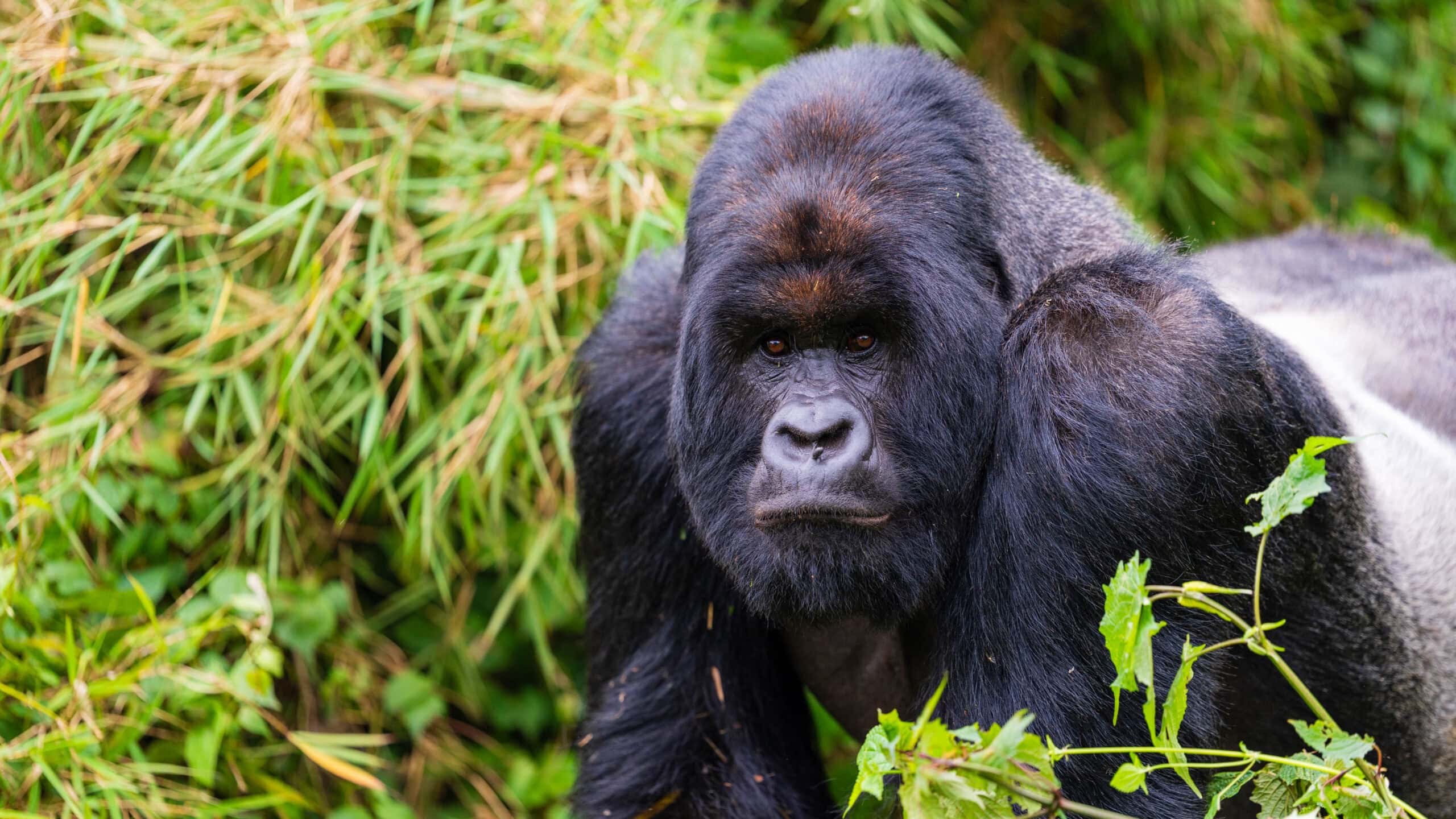
Guide to Gorilla Trekking in Rwanda: Costs, Photography Tips, Essential Info, and Review
Gorilla trekking in Rwanda is, without a doubt, one of the top-tier wildlife bucket list opportunities the world offers. And after experiencing my first gorilla trek, I can 100% say it is a must-do activity when you visit Rwanda.
We got within feet of gorillas of all sizes, witnessing what life is like for these gentle giants on the slopes below the towering volcanic peaks that span the borders of Rwanda, the Democratic Republic of the Congo, and Uganda.
In the 1980s, the mountain gorilla population fell to around 240. Many people feared they would become extinct by the end of the century. Thankfully, concerted conservation efforts, community education, and full support by the Rwandan government have turned the tide, and now there are more than 1000 mountain gorillas.
Explore All Guided Tours in Rwanda
In 2025, mountain gorillas support nearby communities, with 15% of revenue going back to the area (10% to development and 5% as monetary transfers). Rwanda has realized the tremendous opportunity conservation offers for both the animals and the community, with both rising higher and higher together.
If you’re thinking of visiting Rwanda and the mountain gorillas, this guide has everything you need to plan a trip and make this bucket list opportunity a reality.
Easy Booking: Expedia.com | Hotels.com | VRBO | Booking.com | Airbnb.com
Need Gear: Find Gear at REI
Find Awesome Tours: Viator.com or GetYourGuide.com
First time here? Stay in touch by following on IG: @Alecoutside and my newsletter
Iceland on your bucket list? Get my Iceland guide + 144 pinned locations on Google Maps
Please stay safe out there and follow Leave No Trace principles as best you can.
Ultimate Guide to Seeing Gorillas in Rwanda: An Experience You’ll Never Forget
Quick Details on Gorilla Trekking in Rwanda:
- Cost for Americans/Europeans: $1,500
- How long do you get to spend with the gorillas: 1 hour
- How early should you get your permits? At least 3-6 months early, but the dry season can see reservations a year in advance.
- Where to stay: Five Volcanoes Boutique Hotel
- Book a guide to drive you to the start of the trek

First Timer’s Guide and Review: My first time gorilla trekking experience in Rwanda
It was an early wake-up for our group ahead of our gorilla trek. By 6:15, we were all in the restaurant, getting some quick bites to eat before finalizing our gear and heading to the gorilla staging area. Thankfully, it was less than a 15-minute drive from the hotel to the Volcanoes National Park meeting point.
When we arrived, we met our guide, learned what gorilla group we would be with (Tambara), and set off. From there, we had another 15–20-minute drive to the start of our trek. Unlike in the US, where you’d likely start at an established trailhead, we parked alongside the road and started hiking through potato fields.
The Trek
For about a mile, we zigzagged through farm fields before reaching the Volcanoes National Park boundaries. Here, we met another ranger, this one carrying a gun. It wasn’t because there was any inherent danger from humans or gorillas. It was on the off-chance we ran into an elephant or buffalo in the forest.
Another quarter of a mile in, we reached the trackers. It was go time!
Here, we put on our masks. When COVID hit in 2020, researchers and rangers noticed that gorillas got sick less when humans wore masks, and they’ve continued requiring masks for all visitors to gorillas.
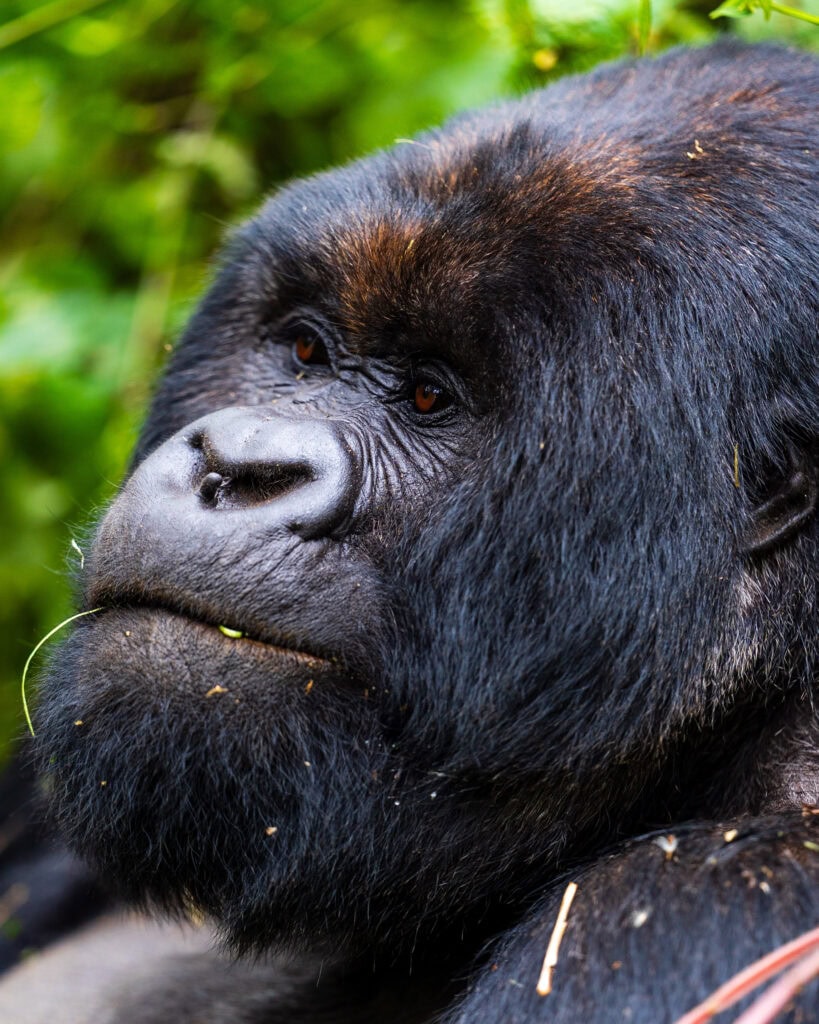
Mountain Gorillas
Just a short distance past the trackers, we encountered our first gorilla on an upslope. It was about as anticlimactic as possible. I didn’t even know what I was looking at for a few moments, considering it was lying on its back – just a big ball of fur.
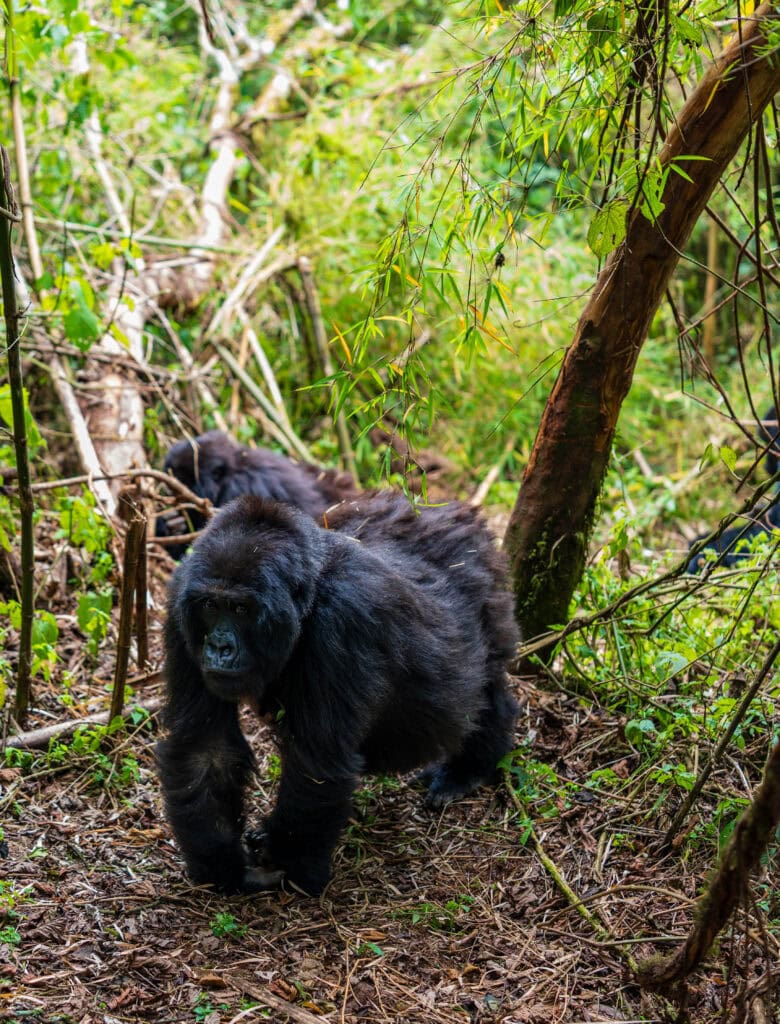
As we traversed the slope on a narrow path with thick bamboo stalks on both sides, our group of six formed a single line on the left side of the trail. Near the top, we stopped and took in the view. Over the next 5-10 minutes, gorillas of all sizes passed by us. If I had taken two steps into the trail, I could have given them a bear hug.
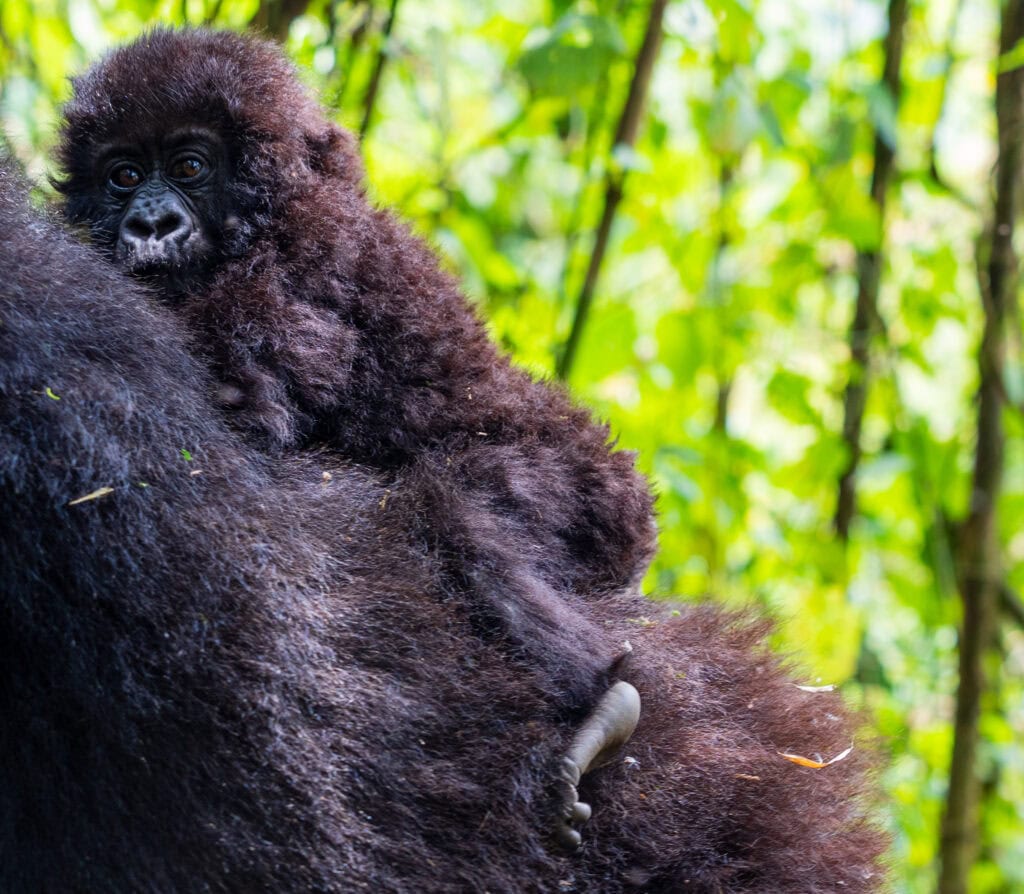
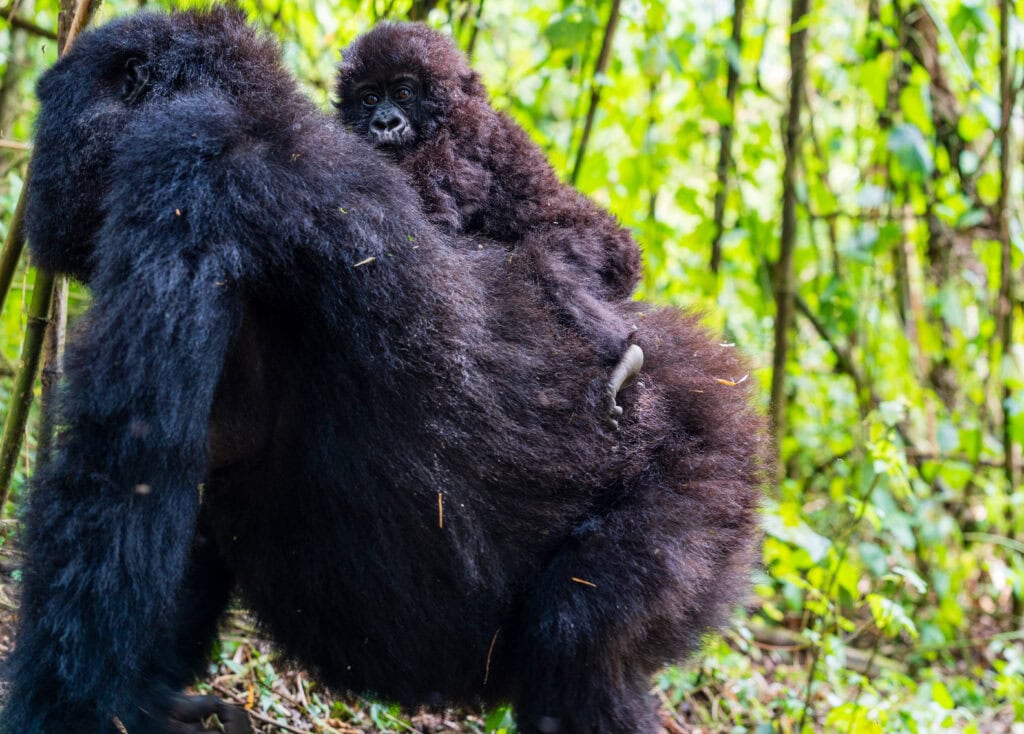
A momma gorilla with a baby on her back marched through. Shortly after, a silverback walked up, sat down, and began pooping. Thirty seconds later, he finished by reaching behind and pulling the last bit out with his fingers. (Incredibly gross, but I was fearful we’d get it flung on us, and because that didn’t happen, it was all good.)
From here, all the gorillas knuckle-walked deeper into the forest. And we followed closely behind. One tracker was in front of us, cutting his way through the forest with his machete as we traversed the steep, bushy terrain.
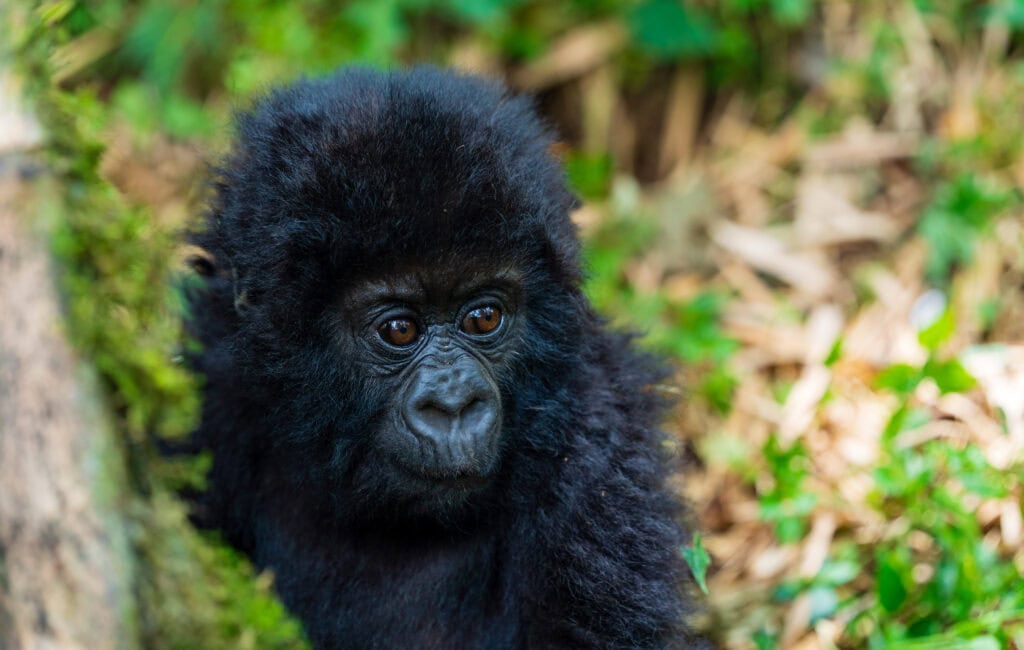
The subsequent encounter was with the mom and her baby. She sat there, looking at us, as her baby rolled around beside her. She had no fear, showed no aggression, and barely even watched her kiddo.
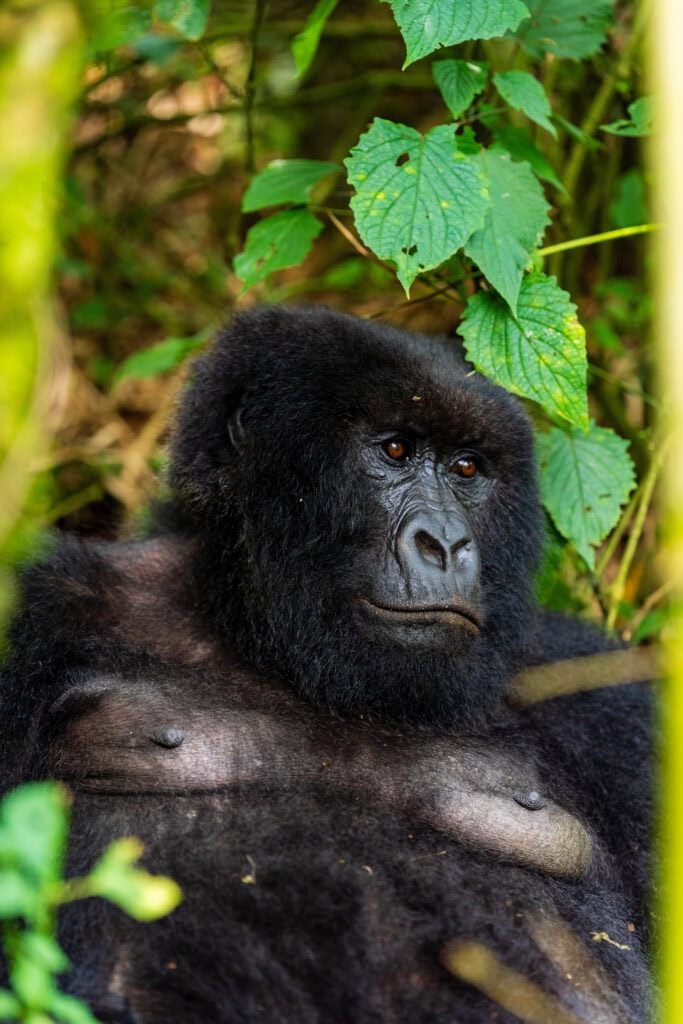
The trust she had in us was incredible.
After a while, she moved on, and so did we. This game of tag continued throughout the forest as the mountain gorillas would move through tight quarters, and we would take roundabout ways to reach them again.
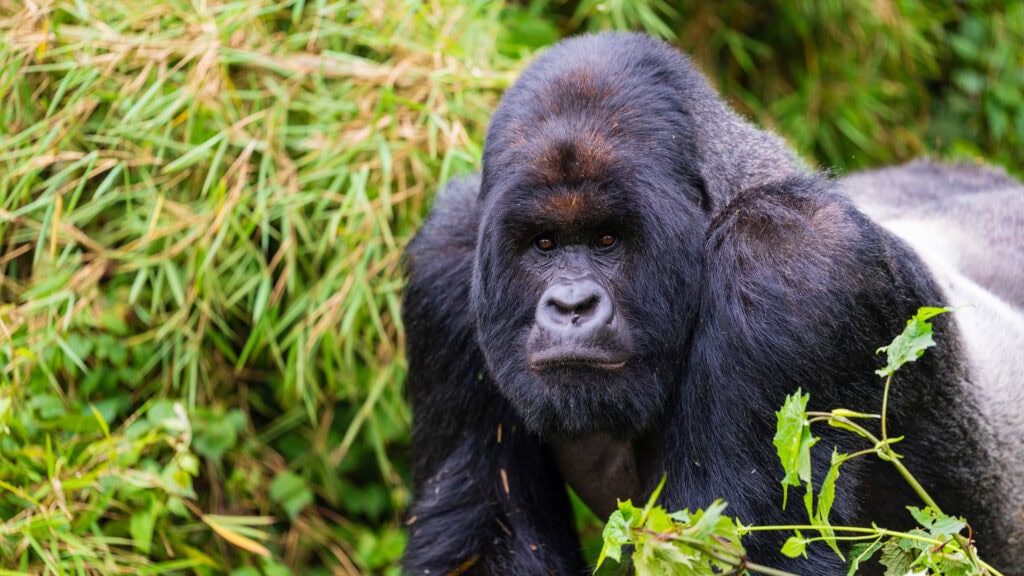
As our one-hour time limit grew nearer, we had one final encounter with mom and baby and the group’s silverback. From higher up, he emerged from the forest and looked out at us on all fours. I was able to land some pretty cool photos of him staring me in the eye.

At the same time, the rain started to fall lightly. Our guide motioned for us to start heading away from them. Our time with this family had come to an end.
We walked down a rooted slope and away from the gorillas into an open meadow. Here, I put away my camera and regrouped with our team of trekkers, porters, trackers, and guide.
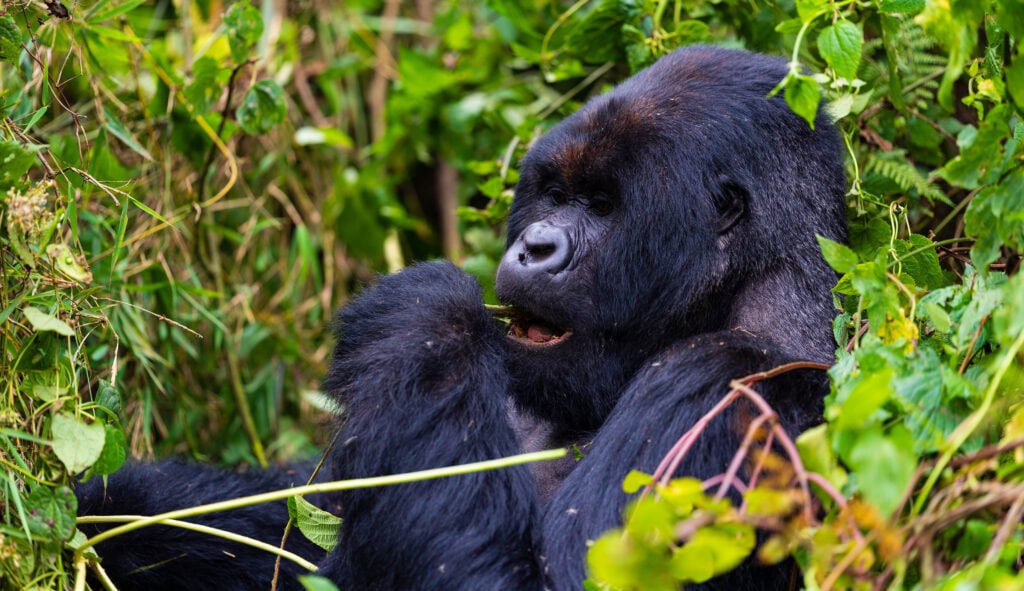

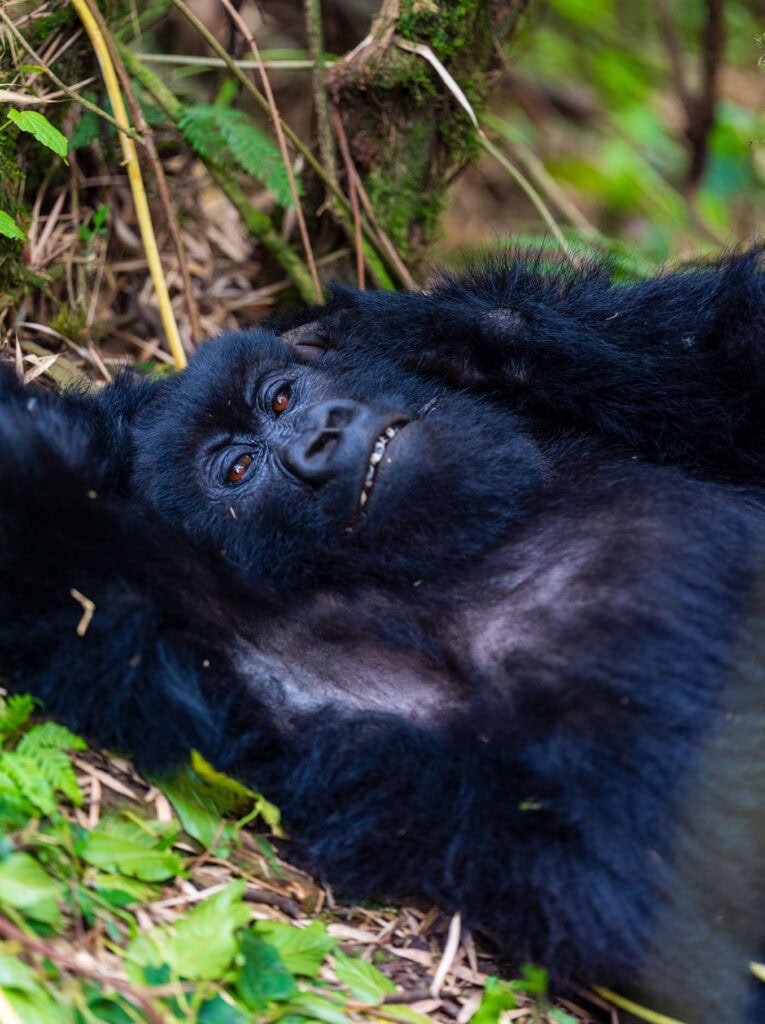
It was a magical experience, getting to see mountain gorillas interact with each other in their natural habitat. No longer threatened, they are growing in numbers (40 new babies in the last 2-3 years) and are becoming a vital component of the Rwandan economy, helping uplift the entire country.
I’m eternally grateful for the opportunity to have seen them in person and help promote the continued conservation of gorillas into the future.
What you need to know about Gorilla Trekking in Rwanda
Are you guaranteed to see gorillas?
While nothing is guaranteed in life, you are 99.9% sure to see mountain gorillas in Rwanda. Trackers spend all day with them and know exactly where they go to sleep and wake up. They are in communication with your guide, who will lead you directly to them.
What is the cost to go trekking for gorillas in Rwanda?
In Rwanda, gorilla trekking is a pricey endeavor and a large part of the economy. For foreigners, it is $1,500 per person to see the gorillas. They do have a tiered system for Africans and Rwandans to make it more affordable.
At this price point, it is truly a bucket list activity for affluent people who can shell out at least $3,000 per couple on top of all the travel and lodging costs to sustain a trip.
Where do mountain gorillas live?
Mountain gorillas live in just two regions: the Virunga Massif, a chain of volcanic mountains spanning Rwanda, Uganda, and the Democratic Republic of Congo, and Uganda’s Bwindi Impenetrable National Park.
These mist-covered forests, sitting between 8,000 and 13,000 feet in elevation, provide the cool, lush habitat that gorillas depend on. Unlike their lowland cousins, mountain gorillas do not survive outside these limited pockets of wilderness, making their home range one of the smallest and most vulnerable of all great apes.
What is so special about Rwandan gorilla trekking?
Forty years ago, the mountain gorilla was on a path to extinction by the end of the 20th century. Thankfully, that trajectory was quelled, and they are healthier than at any time in the last 40 years.
This is what makes visiting them so special. You are getting a chance to see one of the rarest primates in the world. Only 1,000 of them exist (pending census will update numbers by the end of 2025), and spending time with these gentle giants is a magical experience.
How long do you get to spend with the gorillas?
To balance tourism and conservation, you can spend only one hour with mountain gorillas in Rwanda. This time goes by quickly, so soak it all in, take lots of photos, and enjoy the experience with these magnificent, gentle animals.
For me, the time flew by. Especially since we’d see them, then they would walk away, and then we’d follow. So, we didn’t technically get a straight hour with eyes on them at all times.
You are also the only group that will see gorillas that day. While they are habituated, conservationists still want them to be natural and wild. So, once you leave, no one will see them for ~24 hours.
Still, it was an incredible experience and memories I’ll never forget.

Should you tip your guides, porters, and trackers?
Yes, you should tip everyone who helps you on your gorilla trek. There’s not a set amount, but $5-$10 per person is a good range to aim for. For the porters, this is a substantial part of their income, and they rely on tourists to make a living.
How hard is gorilla trekking?
You get to choose the level of difficulty (easy, medium, and hard based on what activity level you want to do that day for your gorilla trek. We chose easy, and it was quite literally easy.
We hiked less than 3.5 miles round trip with fewer than 450 feet of gain. In all, we were out for around three hours. (45 minutes there and back and one hour with the gorillas.)
Our location was just outside of the park’s boundaries, while medium and hard difficulties can have you hiking 4+ hours to reach the gorillas.
How long do gorilla treks last?
As I mentioned above, our gorilla trek was pretty quick at three hours. Others can be full-day expeditions into the mountains in search of gorillas that are further up the volcano slopes.
What should I wear for gorilla trekking in Rwanda?
- Hiking Pants
- Hiking Shirt/Sun Hoodie
- Hat
- Sunglasses (if sunny)
- Rain Jacket
- Waterproof Hiking Boots
- Small backpack with water and snacks (you leave this before you visit the gorillas)
What time do you typically start your trek?
We arrived at the gorilla staging area around 7am. After you are assigned your gorilla group and guide, you’ll head out on the trek.
Is Rwanda safe?
Traveling through Rwanda for a week, I never felt unease. (Though I was on a press trip with a tour guide.) For comparison, Rwanda has the same Level 2 Travel Advisory as France, Germany, and Italy.
So, if you aren’t worried about visiting those European countries, then you’ll be fine. The people here have been so friendly, generous, and hospitable.
Can you see mountain gorillas anywhere else?
Yes, mountain gorillas live in Uganda and the Democratic Republic of the Congo.
Unfortunately, the eastern side of the DRC has been in conflict for the last few years, and the area where you’ll be gorilla trekking is currently under a Level 4 “Do Not Travel” risk from the US State Department.
You can also visit them in Uganda. This tends to be more strenuous terrain to reach the gorillas, but all accounts suggest it’s a safe environment – at least while you’re with the guides.
Uganda does have a Level 3 Travel Advisory to ‘Avoid Travel.’

Is gorilla trekking worth it in Rwanda? My Review
I do believe that gorilla trekking is worth it, due to the unique nature of the experience and the fact that mountain gorillas are incredibly rare. It was a phenomenal time in the forest with these animals, and the ability to get up close and personal is unrivaled.
But the cost is substantial for most people worldwide. Only a few places in the world let you see mountain gorillas, and the safest place is Rwanda. And with that comes a hefty price tag.
If money is no object to you, then yes, gorilla trekking in Rwanda is one million percent worth it. For this income bracket, $1,500 is probably a drop in the bucket. It becomes dicey and harder to weigh if you aren’t very, very well off.
I won’t lie to you all, a trip to Rwanda from America, including the gorilla trekking, will likely cost you $7,000, including flights. That’s a very good chunk of change.
Where to Stay for Your Gorilla Trek?
For our gorilla trek, we stayed at the Five Volcanoes Boutique Hotel. It is a beautiful hotel with fantastic hospitality and is a short 20-minute drive to the staging area.
The hotel has a spa/massage, its own restaurant with delicious food, and a pool to hang out in. I would highly recommend staying here before and after gorilla trekking. (They will also help you out with permits and other necessary details.)
Book here on Expedia | Hotels.com| Agoda
Find other hotels near Volcanoes National Park
Photography Tips for your Gorilla Trek
The mid-zoom lens is perfect
I used the Sony 50-150 f/2, while my trip mate used my 24-105 f/4. I found mine perfect, though a couple of times the gorillas were less than a yard from us, and a wider lens would have been nice. Another group member said the 24-105 worked great for her.
Come prepared, but expect to only use one lens
I came prepared with multiple bodies and telephoto lenses that were never used. I honestly had no idea what to expect, and we ended up in a dense forest instead of an open area.
We had no time to change lenses, nor any need for a long zoom lens, since we were mere yards (or closer) from the gorillas at all times.
Shutter Speed Doesn’t Need to be too high
Gorillas are not fast-moving animals. This is nice for photography as you don’t need your shutter speed to be too high. I had mine in the 320-500 range.
Make sure to check out my dedicated article on photographing gorillas in Rwanda at a later date.
Tripod was impossible to use for me.
I brought a tripod on the trek and never even considered using it once we got on-site. Things were happening too fast, we were too scrunched together, and it was pure run-and-gun. A tripod would have been too clunky in our environment.
If your gorilla trek brings you to an open area, then it would be nice. For us, it didn’t make sense.
Why I rented the Sony 50-150?
The new Sony 50-150 is an f/2 lens, which means you’re two full stops lower than an f/2.8 lens and lets in far more light. This was top of mind, as I correctly assumed we would be in the forest and have some cloud cover, decreasing natural light.
I found this to be the PERFECT lens for gorilla photography and would recommend it to others on your own trek.
What other lenses could work?
I would recommend the 24-105 as well as the 70-200. For how close we were to the gorillas, having a wider field was nicer than having more zoom. I think a third-party lens like the Tamron 18-300, 35-150, or 28-200 would work as well. (You’ll sacrifice lower aperture levels when zoomed in fully, and you’ll need to adjust accordingly with a slower shutter speed or higher ISO.)
Professional Photos from our day trekking gorillas in Rwanda
Enjoy the photos I took on our gorilla trek. I would be honored if you wanted to purchase these for your home or office.




Final thoughts on my first time gorilla trekking in Rwanda
Trekking for gorillas is one of the most remarkable and unique activities one can do in Rwanda and Africa. These giants were almost poached to extinction, but thanks to conservation efforts throughout Rwanda and the Volcanoes area, they are thriving.
Having the opportunity to spend time with them, see how they interact, how they smell (not great), and experience the full trekking process was fantastic.
I know it’s a pretty penny to do the trek, but if you have the disposable income, it is so worth it. It’s a true bucket-list experience you’ll remember forever.
Until next time, adventurers, stay safe.
Follow on social media: TikTok || Instagram || Facebook || Newsletter | YouTube